How to Delegate Content Production in Your Organization
Expand online learning content creation across your organization. Read tips on how to engage...
The working life is changing rapidly, and in addition to hard skills, soft skills such as communication, collaboration, leadership, and problem-solving can be key factors in an organization's success. But how do you teach them digitally?
In this blog, we share tips on how digital learning platforms can support soft skills training.
Soft skills refer to abilities that influence how we communicate, collaborate, resolve conflicts, and act in different situations. They are not tied to a specific profession or technical expertise but have a broad impact on workplace interaction and team effectiveness. They support for example customer relationships or teamwork: strong communication skills build trust and customer satisfaction; effective interaction reduces friction and improves productivity. Examples of soft skills include:
Soft skills can also be developed effectively in a digital learning environment. Digital learning platforms offer interactive tasks, continuous feedback and assessment, and personalized learning paths that support soft skills training. Digital learning material for soft skills training can include for example virtual lectures, articles, podcasts, videos, discussions, and tasks.
Here are some tips on how to train different soft skills using tasks in a digital learning platform:
Communication in difficult situations: Create realistic scenarios, such as a customer service situation with an unhappy client or a team meeting with a misunderstanding. Provide options for the learner on how they would respond in the situation, or let them write or record their own responses.
Listening and nonverbal communication: Embed a short video of a conversation to the platform and ask questions about the speaker's intended message or body language. Learners can choose or write an interpretation and receive feedback based on their answers.
Clear communication: Give a complex message and ask the learner to rewrite it in a clear and understandable manner. Show a model answer or assess the answers manually. You can also allow peer review so learners can see multiple versions and learn from each other, saving instructor's time.
Giving feedback: Present a situation where constructive feedback is needed. Learners write their version and compare it to a model version. They can also submit a video response.
Teamwork: Give reflective questions for a group discussion about teamwork, such as "How do you make sure that everyone in the team feels heard? What makes teamwork smooth and effective? How can the team help you to develop? What does a good team spirit mean to you?" Learners can share their thoughts on the topic. You can also create scenarios related to teamwork that the group needs to discuss, for example a situation where the team members disagree on a project's direction.
Problem-solving: Present a complex situation (e.g. a delayed client project) and ask the learner to suggest a solution to the situation, either via multiple-choice or open-ended questions. You can also utilize social learning and ask the learners to share three solutions to the problem in a group discussion and comment on others' ideas.
Prioritization exercise: Give a list of problems or tasks and ask the learner to organize them by importance.
Leadership simulations: Present a scenario and a question, for example: "The team's motivation is dropping - what do you do?" The learner chooses or writes an answers. This can also be a topic for a group discussion.
Decision-making: Ask "What would you do in this situation?" questions.
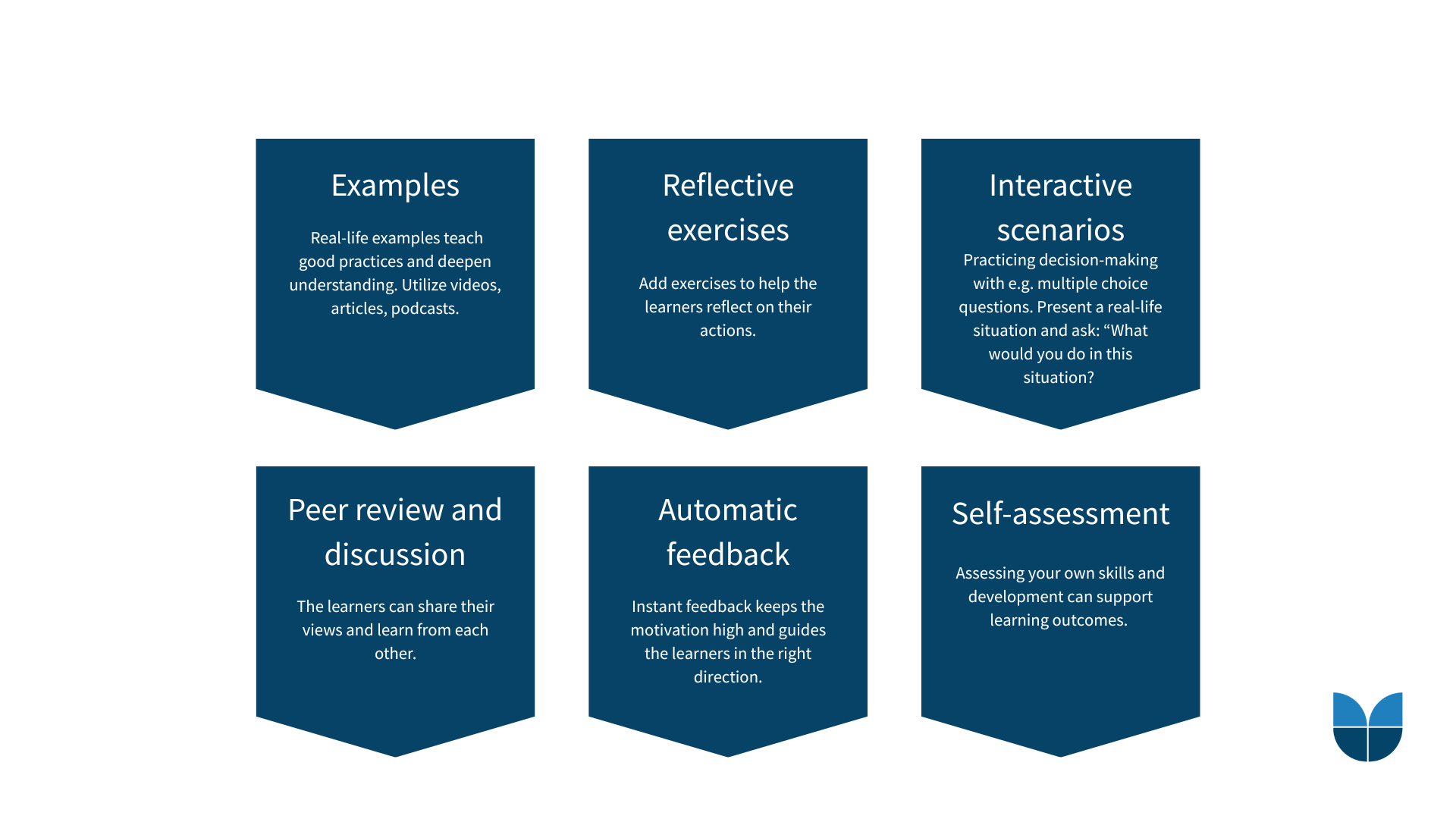
Ways to train soft skills.
Assessing and measuring progress in soft skills can be challenging, because it is not about knowledge but behavior and attitudes. Here are a few methods:
Assignments like "How would you react to this team situation? How would you answer this customer feedback?" test decision-making and interaction skills. You can use tests at the beginning of a course to assess baseline skills or at the end to track progress. You can ask the responses in written form or as answers to multiple choice questions. You can also use video-based tasks where the learners record their solutions.
Learners can evaluate their own skills or development on a scale, identify their strengths, and write learning journals. These can be implemented through survey elements or open questions. Ask for example: "What are your strengths as a leader?", "Rate your ability in the following situations on a scale of 1-5."
Utilize automatic feedback, instructors' comments, and peer reviews.
In automatically graded tasks, such as multiple choice questions, the feedback is immediate, which guides learning in the right direction and can boost motivation to learn. Make sure that the feedback texts are clear and encouraging.
Personal feedback from the instructor helps the learners to understand where they did well and what skills need improvement. It can also increase engagement: learners feel their efforts are recognized and valued. Especially for tasks that require significant effort from the learner (such as learning journals, longer essays, or video responses), the instructors should invest in giving personal feedback.
The assessment workload can be made easier with peer reviews where the learners assess each other's work and learn different perspectives.
Organizations that invest in developing soft skills build stronger teams, better customer experiences, and sustainable competitive advantage. Digital learning environments are a flexible and efficient way to develop soft skills through scenarios and self-assessments. When soft skills training is interactive and realistic, learning supports both individual and organizational success.
Expand online learning content creation across your organization. Read tips on how to engage...
Discover tips on how online training and online learning platforms can enhance employee engagement,...
Learn how Vuolearning integrations simplify everyday work, support managers, and make the impact of...